Project Description
Cesare Tacchi
Biography
He made his debut as an artist in 1959, exhibiting together with Mambor and Schifano at the Appia Antica gallery in Rome. It is part of the movement of the so-called Piazza del Popolo School, born in the sixties in Rome, which gravitated around the Caffè Rosati and the Galleria La Tartaruga by Plinio de Martiis.
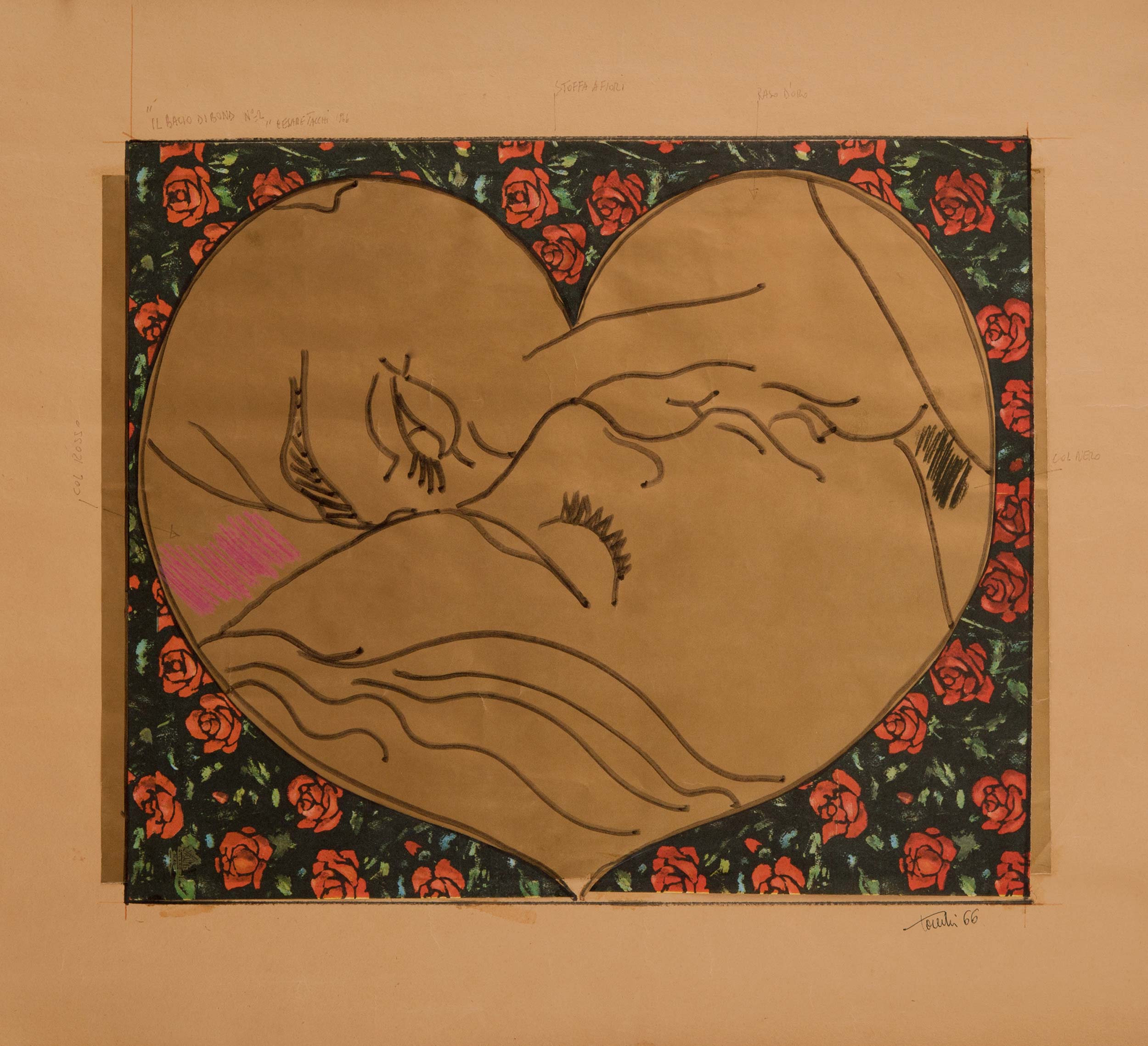
In his paintings he reproduces symbols, objects and characters of the contemporary urban landscape, advertising signs, cars, trams, taxis, elevators, bourgeois living rooms: not to contest the system, but almost to decode reality in the unreality of the work, releasing a strong metaphysical tension. In 1964 he began to use, as a support for the images, tapestries, brocades and furnishing fabrics, padded and quilted, on which he modeled a painting that ironically recovers the “floral” elegance of Botticelli and Pisanello.
The performance “Artist’s Cancellation”, performed in 1968 for the “Il Teatro delle Mostre” cycle at the La Tartaruga gallery, constitutes a sort of watershed in the artistic and human life of Cesare Tacchi: it is a symbolic act that preludes a long decade of individual denial of painting, and at the same time represents the profound crisis of the entire community: the end of the legendary ’60s. Around 1970, Tacchi created a series of object-paintings in which the empty frame takes on the role of protagonist. Tacchi slowly overcomes the crisis, re-elaborating an extremely refined painting, which draws stylized quotations and evocative signs from his repertoire of “artificial nature”. Since the 1980s he has therefore returned to the canvas, in a reconstructive process according to which the color is pure, the brushstroke flat, the sign guided by mathematical logic.